
According to the National Financial Educators Council, 47% of US adults continue to give their personal finance knowledge a grade of “C” or worse. If you’re among those feeling uncertain about your money management, a personal finance audit can transform your financial future. This comprehensive review of your finances helps identify strengths, weaknesses, and opportunities for improvement.
Key Takeaways: Personal Finance Audit Essentials
- A personal finance audit reveals your complete financial picture and spending patterns
- Regular audits help you track progress toward financial goals and identify problem areas
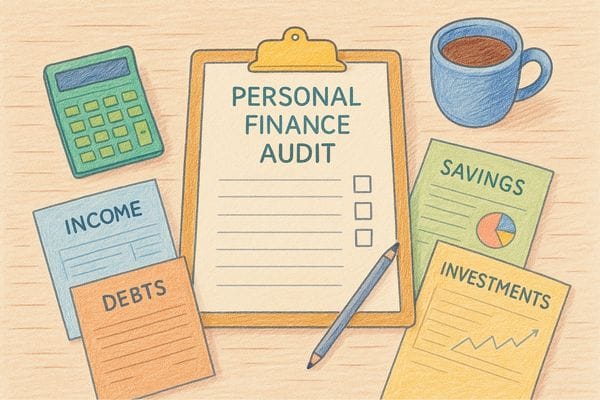
- The process involves reviewing income, expenses, debts, savings, and investment accounts
- Annual or semi-annual audits keep your finances aligned with changing life circumstances
- Professional tools and apps can streamline the audit process and provide valuable insights
- Understanding What a Personal Finance Audit Entails
- Gathering Essential Financial Documents
- Analyzing Your Income Sources and Stability
- Evaluating Monthly Expenses and Spending Patterns
- Assessing Debt Obligations and Payment Strategies
- Reviewing Savings and Emergency Fund Status
- Examining Investment Portfolio Performance
- Setting and Tracking Financial Goals
- Creating an Action Plan for Financial Improvement
- Frequently Asked Questions
- Conclusion
Understanding What a Personal Finance Audit Entails
A personal finance audit represents a comprehensive evaluation of your current financial situation. Think of it as a financial health checkup that examines every aspect of your money management. This systematic review helps you understand where your money comes from, where it goes, and how effectively you’re building wealth.
The audit process involves gathering all financial documents, analyzing spending patterns, and assessing your progress toward financial goals. Unlike a simple budget review, a comprehensive audit examines your complete financial ecosystem, including investments, insurance coverage, and long-term planning strategies.
Many people avoid conducting regular financial audits because they fear what they might discover. However, this exercise provides the foundation for making informed decisions about your financial future. Without understanding your current position, you cannot create an effective plan for reaching your goals.
Gathering Essential Financial Documents
Before beginning your personal finance audit, collect all relevant financial documents from the past year. Start with bank statements from checking and savings accounts, including any money market or certificate of deposit accounts. These documents reveal your cash flow patterns and savings habits.
Credit card statements provide insight into your spending patterns and debt obligations. Gather statements from all cards, including store credit cards and business cards if you own a company. Pay particular attention to interest rates and minimum payment requirements for each account.
Investment account statements show your long-term wealth-building progress. Include retirement accounts like 401(k)s, IRAs, and Roth IRAs, as well as taxable investment accounts. Don’t forget about employer stock purchase plans or other specialized investment vehicles.
Insurance policies and tax returns complete your document collection. Insurance policies protect your financial future, while tax returns provide a comprehensive view of your annual income and deductions. Having these documents readily available ensures a thorough and accurate audit.
Analyzing Your Income Sources and Stability
Income analysis forms the foundation of any effective personal finance audit. Calculate your total gross income from all sources, including salary, freelance work, investment dividends, rental income, and any side businesses. Understanding your complete income picture helps you make informed spending and saving decisions.
Evaluate the stability and reliability of each income source. Full-time employment typically provides the most stable income, while freelance or commission-based work may fluctuate significantly. Identify which income sources you can count on consistently and which ones require backup planning.
Consider the growth potential of your various income streams. Some jobs offer clear advancement paths and regular raises, while others may have limited earning potential. If your primary income source lacks growth opportunities, explore ways to develop additional revenue streams or enhance your skills.
Document any seasonal variations in your income. Many businesses experience busy and slow periods throughout the year. Understanding these patterns helps you budget more effectively and build appropriate emergency reserves for leaner months.
Evaluating Monthly Expenses and Spending Patterns
Categorizing your expenses reveals spending patterns that may surprise you. Divide expenses into fixed costs like rent or mortgage payments, insurance premiums, and loan payments. These expenses remain relatively constant each month and represent your baseline financial obligations.
Variable expenses include groceries, utilities, gasoline, and entertainment. These costs fluctuate but are necessary for daily living. Track these expenses carefully to identify trends and opportunities for optimization without sacrificing your quality of life.
Discretionary spending encompasses restaurants, shopping, hobbies, and other non-essential purchases. This category often provides the greatest opportunities for cost reduction when you need to free up money for savings or debt repayment. Review these expenses critically to ensure they align with your values and priorities.
Use the 50/30/20 rule as a benchmark for evaluating your expense allocation. This guideline suggests spending 50% of after-tax income on needs, 30% on wants, and 20% on savings and debt repayment. Compare your actual spending to these percentages to identify areas for improvement.
Assessing Debt Obligations and Payment Strategies
Debt analysis requires careful examination of all outstanding balances, interest rates, and payment terms. List every debt, including credit cards, student loans, auto loans, mortgages, and personal loans. Calculate the total amount owed and the minimum monthly payments required.
Interest rates significantly impact the total cost of your debt over time. High-interest debt, particularly credit card balances, should receive priority attention in your repayment strategy. Consider debt consolidation or balance transfer options if they offer lower interest rates.
Evaluate your debt-to-income ratio by dividing your total monthly debt payments by your gross monthly income. Financial experts generally recommend keeping this ratio below 36%, with no more than 28% going toward housing costs. Higher ratios may indicate the need for aggressive debt reduction strategies.
Create a debt repayment plan using either the debt snowball or debt avalanche method. The snowball method focuses on paying off the smallest balances first, while the avalanche method targets the highest interest rates. Choose the approach that best matches your personality and motivation style.
Reviewing Savings and Emergency Fund Status
Emergency fund analysis reveals your financial resilience during unexpected situations. Financial experts recommend maintaining three to six months of living expenses in an easily accessible savings account. Calculate your monthly essential expenses and multiply by your target number of months.
Evaluate the accessibility and growth potential of your emergency savings. High-yield savings accounts or money market accounts provide better returns than traditional savings accounts while maintaining liquidity. Avoid tying up emergency funds in investments that may lose value when you need the money most.
Review your progress toward other savings goals, such as vacation funds, home down payments, or vehicle purchases. Separate these targeted savings from your emergency fund to avoid accidentally spending money earmarked for specific purposes.
Consider automating your savings to ensure consistent progress toward your goals. Automatic transfers from checking to savings accounts remove the temptation to spend money before saving it. Start with small amounts and gradually increase your savings rate as your income grows.
Examining Investment Portfolio Performance
Investment portfolio analysis requires reviewing asset allocation, performance, and fees across all accounts. Examine your mix of stocks, bonds, and other investments to ensure it aligns with your risk tolerance and time horizon. Younger investors typically benefit from higher stock allocations, while those nearing retirement may prefer more conservative investments.
Compare your investment performance to relevant benchmarks and market indices. While short-term fluctuations are normal, consistent underperformance may indicate the need for portfolio adjustments. Focus on long-term trends rather than daily or monthly fluctuations when evaluating performance.
Investment fees can significantly impact your long-term returns. Review expense ratios for mutual funds and ETFs, as well as advisory fees for managed accounts. High fees eat into your returns over time, so consider lower-cost alternatives when appropriate.
Rebalancing your portfolio ensures your asset allocation remains aligned with your investment strategy. Market movements can cause your portfolio to drift from your target allocation, requiring periodic adjustments to maintain your desired risk level.
Setting and Tracking Financial Goals
Goal setting transforms your personal finance audit from a review exercise into an action plan. Establish specific, measurable, achievable, relevant, and time-bound (SMART) financial goals. Instead of vague objectives like “save more money,” set concrete targets like “save $10,000 for an emergency fund within 18 months.”
Categorize your goals by timeframe: short-term (less than one year), medium-term (one to five years), and long-term (more than five years). This categorization helps you prioritize your efforts and choose appropriate savings and investment strategies for each goal.
Track your progress regularly using spreadsheets, apps, or financial planning software. Visual progress indicators, such as charts or progress bars, provide motivation and help you stay on track. Celebrate milestones along the way to maintain momentum toward larger goals.
Adjust your goals as circumstances change. Life events like marriage, divorce, job changes, or health issues may require modifications to your financial objectives. Regular audits help you identify when goal adjustments are necessary and ensure your plans remain realistic and achievable.
Creating an Action Plan for Financial Improvement
Your personal finance audit should conclude with a comprehensive action plan addressing identified weaknesses and opportunities. Prioritize actions based on their potential impact and your available resources. Focus on high-impact changes first, such as eliminating high-interest debt or increasing your emergency fund.
Establish timelines for implementing each improvement. Some changes, like switching to a high-yield savings account, can be completed quickly. Others, such as paying off significant debt or building substantial savings, require longer-term commitment and consistent effort.
Consider working with financial professionals if your situation is complex or you need additional guidance. Financial advisors, tax professionals, and estate planning attorneys can provide specialized expertise for specific aspects of your financial plan.
Regular monitoring ensures your action plan remains on track. Schedule quarterly mini-audits to review progress and make necessary adjustments. Annual comprehensive audits help you assess your overall financial health and plan for the year ahead.
Frequently Asked Questions
What is the difference between a financial audit and a budget review?
A personal finance audit provides a comprehensive examination of your entire financial situation, while a budget review focuses primarily on income and expenses for a specific period. The audit process includes analyzing investments, insurance coverage, debt obligations, and long-term financial goals. It also evaluates your progress toward financial objectives and identifies opportunities for improvement across all areas of your financial life. Budget reviews, while important, represent just one component of a complete financial audit.
How often should I conduct a personal finance audit?
Most financial experts recommend conducting a comprehensive personal finance audit annually, with mini-audits quarterly. Annual audits allow sufficient time for meaningful changes in your financial situation while ensuring you don’t drift too far off course. However, major life events such as marriage, divorce, job changes, or significant income fluctuations may warrant immediate audits. Quarterly check-ins help you stay on track with your financial goals and make minor adjustments as needed throughout the year.
Can I use software or apps to help with my financial audit?
Yes, numerous software programs and mobile apps can streamline the audit process and provide valuable insights. Popular options include Mint, YNAB (You Need A Budget), Personal Capital, and Quicken. These tools automatically categorize transactions, track spending patterns, and monitor investment performance. However, technology should supplement, not replace, your critical thinking about your financial situation. Review the categorizations and insights provided by these tools to ensure accuracy and relevance to your specific circumstances.
What should I do if my audit reveals serious financial problems?
If your audit uncovers significant financial challenges, such as overwhelming debt or insufficient emergency savings, don’t panic. Start by prioritizing the most critical issues, such as ensuring you can meet basic living expenses and minimum debt payments. Consider consulting with a non-profit credit counseling agency for free or low-cost guidance. Create a realistic action plan that addresses problems systematically rather than trying to fix everything at once. Focus on small, achievable improvements that build momentum toward larger financial goals.
How do I determine if my investment portfolio is properly diversified?
Portfolio diversification involves spreading investments across different asset classes, geographic regions, and market sectors to reduce risk. A well-diversified portfolio typically includes domestic and international stocks, bonds, and potentially alternative investments like real estate investment trusts (REITs). Your age, risk tolerance, and investment timeline should influence your asset allocation. Many financial advisors recommend the “120 minus your age” rule for stock allocation, meaning a 30-year-old might hold 90% stocks and 10% bonds. Review your holdings to ensure you’re not overly concentrated in any single investment or sector.
Should I pay off debt or save money first?
The answer depends on your specific situation, particularly your interest rates and current emergency fund status. Generally, prioritize building a small emergency fund ($1,000-$2,500) before aggressively paying down debt. This prevents you from relying on credit cards for unexpected expenses. After establishing basic emergency savings, focus on high-interest debt (typically anything above 6-8% interest) before building larger savings. However, always maintain minimum payments on all debts and contribute enough to employer retirement plans to capture any matching contributions, as this represents an immediate 100% return on investment.
What documents should I keep after completing my audit?
Maintain permanent records of tax returns, investment account statements, insurance policies, and legal documents like wills or trusts. Keep the most recent statements for bank accounts, credit cards, and loans, discarding older statements after reconciling them. Store important documents in a fireproof safe or secure digital storage system. Create a simple filing system that makes it easy to locate documents quickly. Consider providing copies of essential documents to a trusted family member or advisor. Digital storage offers convenience and space savings, but ensure you have secure backup systems in place.
Conclusion
A thorough personal finance audit serves as your roadmap to financial success and security. By systematically examining your income, expenses, debts, savings, and investments, you gain the clarity needed to make informed financial decisions. This process reveals both strengths to build upon and weaknesses to address in your money management approach.
Remember that conducting an audit is just the beginning. The real value comes from implementing the insights you discover and making consistent progress toward your financial goals. Start with small, manageable changes that fit your lifestyle and gradually work toward larger transformations.
Your financial situation will continue evolving throughout your life. Regular audits ensure your money management strategies remain aligned with your changing circumstances and goals. Take action today by gathering your financial documents and beginning your first comprehensive audit. Your future financial self will thank you for this investment in your financial education and planning.


