
According to the Experian 2024 Consumer Credit Review, the average American household carried approximately $105,056 in debt. Meanwhile, many Americans struggle to save adequately for retirement. This precarious balance raises an important question: is paying off debt with retirement savings a viable strategy or a financial misstep? The right choice depends entirely on your personal circumstances, the type of debt you’re facing, and your long-term financial goals.
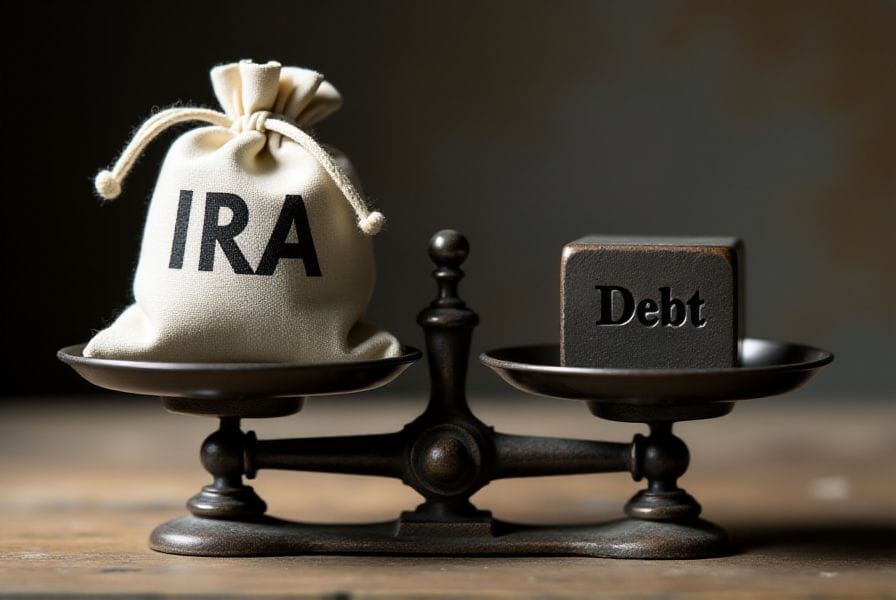
- The Retirement vs. Debt Dilemma: Understanding Your Options
- The True Cost of Tapping Retirement Accounts for Debt Repayment
- When Using Retirement Funds to Pay Debt Might Make Sense
- Smart Alternatives to Consider Before Tapping Retirement Accounts
- Understanding the Tax Implications of Retirement Withdrawals for Debt
- The Psychological Benefits and Drawbacks of Debt Elimination
- Special Considerations for Different Types of Retirement Accounts
- How to Rebuild Retirement Savings After Using Them for Debt
- Frequently Asked Questions
- Conclusion: Making the Right Choice for Your Financial Future
The Retirement vs. Debt Dilemma: Understanding Your Options
When facing mounting debt and the stress it brings, tapping into retirement funds can seem like an attractive solution. After all, why let debt accumulate interest when you have money sitting in a retirement account? However, this decision carries significant long-term implications that deserve careful consideration.
Let’s explore when this approach might make sense, when it could be detrimental, and what alternatives you should consider before making this consequential financial decision.
The True Cost of Tapping Retirement Accounts for Debt Repayment
When considering paying off debt with retirement savings, understanding the full cost is essential. The expenses go far beyond the simple dollar amount you withdraw.
First, early withdrawals from retirement accounts like 401(k)s or traditional IRAs before age 59½ typically incur a 10% penalty. This means a $10,000 withdrawal immediately costs you $1,000 in penalties alone.
Beyond penalties, you’ll face taxes on the withdrawal amount. Since most retirement contributions are made with pre-tax dollars, withdrawals are taxed as ordinary income. Depending on your tax bracket, this could mean paying 12%, 22%, or even 37% of your withdrawal to federal taxes, plus state taxes where applicable.
The combination of penalties and taxes can dramatically reduce the value of your withdrawal. For example, if you’re in the 22% federal tax bracket and withdraw $20,000 from your 401(k), you could lose $6,400 to penalties and taxes, leaving just $13,600 to pay down debt.
Perhaps most significant is the opportunity cost of removing money from your retirement accounts. When you withdraw funds, you lose the potential compound growth those investments would have generated over decades. A $25,000 withdrawal at age 40 could represent over $150,000 in lost retirement savings by age 65, assuming a 7% average annual return.
Tax-advantaged retirement accounts also offer protection from creditors in bankruptcy proceedings in many states, a benefit you forfeit when withdrawing funds. This protection could be valuable should your financial situation deteriorate further.
Finally, employers often stop matching 401(k) contributions when loans are taken, representing additional lost compensation if you choose the loan option instead of a direct withdrawal.
Before tapping retirement savings, calculate the true cost by adding penalties, taxes, lost growth, and potential lost employer matches. The total frequently makes this option far more expensive than alternative debt repayment strategies.
When Using Retirement Funds to Pay Debt Might Make Sense
Despite the significant costs, there are limited circumstances when using retirement savings to address debt may be justifiable.
High-interest debt, particularly credit cards with rates exceeding 18-20%, creates a financial hemorrhage that can be difficult to overcome. If you’ve exhausted other options like balance transfers, debt consolidation, or negotiating with creditors, using retirement funds to eliminate high-interest debt could potentially save money over time, especially if the interest you’re paying exceeds the expected returns on your investments.
When facing foreclosure or eviction, preserving your primary residence might outweigh retirement savings concerns. Homelessness creates cascading financial and personal problems that can be far more devastating than a reduced retirement account.
Medical debt, particularly when facing collections or legal action, sometimes warrants consideration of retirement withdrawals. Medical debt can severely impact credit scores and lead to wage garnishment, and often comes with emotional distress during already difficult health situations.
Some retirement plans allow hardship withdrawals without the typical 10% early withdrawal penalty in specific circumstances, such as preventing eviction or foreclosure, covering certain medical expenses, or paying for higher education. These exceptions don’t eliminate income taxes but do reduce the overall penalty cost.
A 401(k) loan, rather than a withdrawal, might offer a better option in some cases. You’re essentially borrowing from yourself and repaying with interest to your own account. However, these loans typically must be repaid within five years, and if you leave your job, the entire balance often becomes due within 60-90 days.
The CARES Act of 2020 and subsequent legislation temporarily expanded access to retirement funds without penalties during the COVID-19 pandemic, establishing precedent that similar provisions might be available during future national emergencies.
Before proceeding with any retirement fund withdrawal, consult with a financial advisor who can help evaluate your specific situation, explore all alternatives, and minimize the long-term impact if withdrawal becomes necessary.
Smart Alternatives to Consider Before Tapping Retirement Accounts
Before making the significant decision to use retirement savings for debt repayment, explore these potentially less costly alternatives.
Debt consolidation loans can combine multiple high-interest debts into a single loan with a lower interest rate. Many credit unions and online lenders offer these products with rates significantly below credit card interest rates, potentially saving thousands in interest while simplifying your payment schedule.
Balance transfer credit cards with promotional 0% APR periods allow you to move high-interest debt to a new card and pay no interest during the introductory period, typically 12-21 months. This option works best if you can pay off the debt during the promotional period and qualify for sufficient credit limits.
Negotiate with creditors directly, especially for medical debt or credit card balances. Many creditors will agree to lower interest rates, extended payment terms, or even reduced balances to avoid the risk of getting nothing through bankruptcy. This approach requires persistence but can yield surprising results.
Consider developing a side income through freelancing, part-time work, or selling unwanted items. Dedicating even modest additional income exclusively to debt repayment can accelerate your progress without touching retirement funds.
The debt snowball method (paying smallest debts first) or debt avalanche method (focusing on highest interest debts first) provide structured approaches to debt elimination. These methods have proven psychological and financial benefits that can help you stay motivated through the debt repayment process.
In extreme circumstances, bankruptcy might actually be less financially damaging than depleting retirement accounts. Retirement assets are often protected in bankruptcy proceedings, allowing you to get debt relief while preserving your retirement security.
Housing options like downsizing your home, taking in a roommate, or refinancing your mortgage could free up significant money for debt repayment without affecting retirement savings.
If you’ve exhausted other options and must use retirement funds, consider a 401(k) loan instead of a withdrawal. While not ideal, you’ll avoid penalties and taxes while essentially paying interest to yourself rather than a creditor.
Finally, nonprofit credit counseling agencies can provide personalized advice and may help establish debt management plans with reduced interest rates and consolidated payments without affecting your retirement savings.
Understanding the Tax Implications of Retirement Withdrawals for Debt
The tax consequences of using retirement funds for debt repayment can be complex and significant, potentially creating new financial problems while solving others.
Traditional 401(k) and IRA withdrawals are taxed as ordinary income, potentially pushing you into a higher tax bracket. For example, if your taxable income is normally $50,000 (22% bracket) and you withdraw $30,000, part of that withdrawal could be taxed at 24%, increasing your tax liability beyond what you might expect.
The 10% early withdrawal penalty applies to most distributions before age 59½, with limited exceptions. This penalty is calculated on the total withdrawal amount, not your net after taxes.
Roth accounts have different rules. Contributions to Roth IRAs can be withdrawn at any time without taxes or penalties, making them somewhat more flexible for emergencies. However, earnings withdrawn before age 59½ and before the account has been open for five years are still subject to taxes and potentially penalties.
Required Minimum Distributions (RMDs) must continue from traditional retirement accounts after age 72, even if you’ve taken early withdrawals. Failing to take RMDs results in steep penalties of 50% of the amount not withdrawn.
State taxes add another layer of complexity. Some states exempt retirement income from taxation, while others tax it fully or partially. Consider your state’s specific rules when calculating the total cost of withdrawal.
The timing of withdrawals matters significantly. Taking large distributions in December gives you little time to plan for the tax impact, while January withdrawals provide nearly a full year to prepare for the tax bill.
Tax-loss harvesting in taxable investment accounts might help offset some of the tax burden from retirement withdrawals, though this strategy has limitations and requires careful planning.
Spreading withdrawals across multiple tax years could potentially reduce the overall tax impact by keeping you in a lower tax bracket each year, though this approach delays complete debt repayment.
Before making any retirement withdrawal for debt repayment, consult with a tax professional who can analyze your specific situation and help minimize the tax impact of your decision.
The Psychological Benefits and Drawbacks of Debt Elimination
Beyond the financial calculations, eliminating debt by using retirement savings carries significant psychological factors worth considering.
The emotional relief of becoming debt-free can be profound and life-changing. Numerous studies have linked debt to anxiety, depression, and even physical health problems. Removing this burden can improve sleep, relationships, and overall wellbeing.
Debt payments can consume mental bandwidth, creating a constant low-level stress that affects decision-making and creativity. Eliminating debt frees cognitive resources for more productive and fulfilling activities.
However, this relief must be balanced against potential future anxiety. Using retirement funds can create new worries about financial security in your elder years, potentially replacing one form of stress with another.
Financial behavior patterns tend to persist unless consciously addressed. If spending habits led to the original debt, using retirement funds without changing those behaviors often results in renewed debt alongside depleted retirement accounts—a significantly worse situation.
Many people report feeling a sense of failure or shame when tapping retirement accounts early, even when the decision makes financial sense. These feelings can impact financial confidence and future decision-making.
The sense of progress in building retirement savings can be motivating and confidence-building. Withdrawing substantial amounts can eliminate this source of positive reinforcement in your financial life.
Some people experience a pendulum swing after becoming debt-free, adopting extremely frugal habits out of fear of returning to debt. While financial caution is generally positive, extreme responses can lead to unnecessarily restricted lifestyles.
Before making a retirement withdrawal decision, honestly assess your emotional relationship with both debt and retirement savings. Consider keeping a financial journal to track your feelings about money decisions, and potentially consult with a financial therapist who can help address unhealthy money behaviors or beliefs.
Special Considerations for Different Types of Retirement Accounts
Different retirement accounts come with unique rules and considerations when weighing whether to use them for debt repayment.
401(k) and 403(b) Plans
These employer-sponsored plans typically allow loans of up to 50% of your vested balance (maximum $50,000). Loans aren’t taxed if repaid according to terms, usually within five years. However, if you leave your job, the loan generally becomes due within 60-90 days, or it converts to a distribution with taxes and penalties.
Hardship withdrawals may be allowed for certain expenses like preventing foreclosure or covering medical costs, but these are still taxable and may be subject to the 10% penalty. Not all plans offer this option, and documentation requirements can be substantial.
Some plans don’t allow withdrawals while still employed, even if you’re willing to pay penalties and taxes. Check your plan’s specific rules before counting on access to these funds.
Traditional IRAs
Unlike 401(k)s, traditional IRAs don’t offer a loan provision. Any withdrawal becomes a taxable distribution, potentially with the 10% early withdrawal penalty.
First-time home purchases qualify for a penalty exemption up to $10,000, though taxes still apply. Similarly, qualified higher education expenses and certain medical expenses may avoid penalties but not income taxes.
The IRS allows penalty-free withdrawals through Substantially Equal Periodic Payments (SEPP) or Rule 72(t) distributions, but these require commitment to a specific withdrawal schedule for at least five years or until age 59½, whichever is longer.
Roth IRAs
Contributions (but not earnings) to Roth IRAs can be withdrawn at any time without taxes or penalties, making them more flexible for emergencies.
Earnings can be withdrawn penalty-free for first-time home purchases up to $10,000 if the account has been open for at least five years.
The ordering rules for Roth withdrawals are favorable—contributions come out first, then conversions, and finally earnings—allowing access to more funds without penalties compared to traditional accounts.
SEP IRAs and SIMPLE IRAs
These small business retirement accounts generally follow traditional IRA rules for withdrawals, though SIMPLE IRAs have a higher 25% penalty (rather than 10%) for withdrawals within the first two years of participation.
Health Savings Accounts (HSAs)
While not strictly retirement accounts, HSAs offer triple tax advantages and can be used penalty-free for qualified medical expenses at any age, including medical debt. After age 65, HSA funds can be used for any purpose without penalty (though non-medical withdrawals are taxed as income).
For each account type, understand the specific rules governing access to funds before making withdrawal decisions. When possible, prioritize withdrawals from accounts with the least penalties and tax consequences.
How to Rebuild Retirement Savings After Using Them for Debt
If you’ve decided to use retirement savings to address debt, implementing a strategic rebuilding plan is essential to secure your long-term financial future.
Immediately increase retirement contributions after eliminating debt. At minimum, contribute enough to receive any employer matching funds, which represents an immediate 50-100% return on investment. Ideally, redirect the entire amount previously going toward debt payments into retirement accounts.
Take advantage of catch-up contributions if you’re 50 or older. In 2024, these allow an additional $7,500 in 401(k) contributions and $1,000 in IRA contributions beyond standard limits, helping accelerate your savings recovery.
Adjust your investment strategy to potentially increase returns, though carefully balanced with appropriate risk tolerance. A slightly more aggressive allocation might help compensate for the withdrawn funds, but avoid taking excessive risks in an attempt to catch up quickly.
Extend your working years if possible. Delaying retirement by even 2-3 years can significantly impact retirement security by providing additional saving time, increasing Social Security benefits, and reducing the number of years your savings must support you.
Consider semi-retirement or part-time work during traditional retirement years. This approach can provide income that reduces reliance on retirement accounts while still offering more flexibility and leisure than full-time employment.
Maximize Social Security benefits by understanding optimal claiming strategies. Delaying benefits until age 70, if possible, can increase your monthly payment by approximately 8% per year beyond full retirement age.
Reduce projected retirement expenses by developing a realistic budget that prioritizes needs over wants. Consider relocating to areas with lower costs of living or downsizing your housing to reduce ongoing expenses.
Address long-term care needs through insurance or alternative planning to protect remaining retirement assets from potential catastrophic healthcare costs.
Regularly review and adjust your rebuilding strategy with a financial advisor. Annual reviews allow for course corrections and provide accountability for your rebuilding efforts.
Remember that rebuilding retirement savings is a marathon, not a sprint. Consistent contributions, even modest ones, will compound over time and help restore your retirement security.
Frequently Asked Questions
Do most people retire debt free?
According to research from the Employee Benefit Research Institute, approximately 67% of households headed by someone 65 or older carry debt into retirement. This represents a significant increase from previous generations. Housing debt represents the largest category, with about 40% of senior households carrying mortgage debt. Most financial advisors recommend entering retirement debt-free if possible, but this goal remains elusive for many Americans.
How much debt does the average retiree have?
The average debt for households headed by adults aged 65-74 is approximately $42,000, though this figure varies widely based on factors including location, education, and career history. Credit card debt averages about $3,200 for this age group, while mortgage debt averages around $35,000 for those who still have mortgages. Medical debt is also increasingly common among retirees, with about 20% reporting some level of healthcare-related debt.
Should I max out my 401k or pay off debt?
This depends on several factors, including the interest rate on your debt and whether your employer offers matching contributions. Generally, advisors recommend first contributing enough to your 401(k) to receive the full employer match, as this represents an immediate 50-100% return on investment. After securing the match, focus on paying off high-interest debt (typically anything over 6-8%), then return to maxing out retirement contributions once high-interest debt is eliminated.
Is it smart to use IRA to pay off debt?
Using IRA funds to pay off debt is rarely considered optimal due to the taxes, potential penalties, and lost growth opportunity. For traditional IRAs, withdrawals before age 59½ typically incur a 10% penalty plus income taxes. While Roth IRA contributions (but not earnings) can be withdrawn penalty-free, you permanently lose the tax-advantaged growth potential. However, if you’re facing extremely high-interest debt (20%+) and have exhausted all other options, the math might occasionally favor using IRA funds, particularly Roth contributions.
What debt is most important to pay off?
Priority for debt repayment should typically follow this order: First, address debt in collections or with legal judgments to avoid wage garnishment or asset seizure. Next, focus on high-interest debt like credit cards or payday loans, as these grow most rapidly. Then address private student loans, which typically have higher rates and fewer protections than federal student loans. Auto loans and personal loans usually come next. Federal student loans often have favorable terms and protections and can be addressed later. Finally, low-interest mortgage debt, especially if tax-deductible, is typically the last debt to prioritize for early repayment.
Can you use a 401k hardship withdrawal to pay off debt?
401(k) plans may allow hardship withdrawals, but debt repayment alone typically doesn’t qualify as a hardship under IRS regulations. Qualifying hardships generally include preventing eviction or foreclosure, covering certain medical expenses, paying for post-secondary education, funeral expenses, or costs related to repairing primary residences. Each plan has specific rules, so check with your plan administrator. Even if you qualify, hardship withdrawals are still subject to income tax and potentially the 10% early withdrawal penalty.
What are the disadvantages of paying off debt?
While paying off debt is generally positive, potential disadvantages include: Depleting emergency funds that might be needed for unexpected expenses; reducing liquidity and access to credit that might be needed in emergencies; potentially lowering your credit score temporarily if you close revolving credit accounts; missing opportunities for more productive uses of capital if the debt has a very low interest rate; losing tax deductions on certain types of debt like mortgage interest or student loan interest; and creating opportunity cost if funds used for debt repayment could have earned higher returns through investments.
Should I cash out my 403b to pay off debt?
Cashing out a 403(b) to pay off debt generally isn’t recommended for the same reasons that apply to 401(k)s and IRAs. Early withdrawals are subject to income tax plus a 10% penalty if you’re under 59½. The taxes and penalties can consume 30-40% of your withdrawal, dramatically reducing the amount available for debt repayment. Additionally, you permanently lose the potential growth of those retirement funds. Consider alternatives like debt consolidation, balance transfers, or lifestyle adjustments before tapping retirement accounts.
What qualifies as a hardship withdrawal?
The IRS allows hardship withdrawals from retirement plans for “immediate and heavy financial needs” that typically include: medical expenses for you, your spouse, or dependents; costs directly related to purchasing a principal residence; tuition and educational fees for the next 12 months for you, your spouse, or dependents; payments necessary to prevent eviction or foreclosure on your principal residence; funeral or burial expenses for immediate family members; and certain expenses for repairing damage to your principal residence. Documentation is required, and you can generally only withdraw what’s needed to address the specific hardship.
Conclusion: Making the Right Choice for Your Financial Future
Deciding whether to use retirement savings to pay off debt requires careful consideration of both immediate financial pressures and long-term retirement security.
The most important takeaway is that this decision shouldn’t be made impulsively. The true cost of early retirement withdrawals extends far beyond the dollar amount taken out, including penalties, taxes, and decades of lost growth potential. For most people, retirement accounts should remain dedicated to their intended purpose—providing financial security in your later years.
Before tapping retirement funds, exhaust all reasonable alternatives. Debt consolidation, balance transfers, creditor negotiations, and structured repayment methods can often address debt concerns while preserving retirement savings. If you do use retirement funds for debt, develop a concrete plan to rebuild those accounts aggressively once the debt is eliminated.
Remember that financial decisions don’t exist in isolation. Consider how using retirement funds might affect your taxes, retirement timeline, and overall financial security. When possible, consult with a financial advisor who can provide personalized guidance based on your complete financial picture.
Ultimately, the goal isn’t just becoming debt-free—it’s achieving comprehensive financial wellbeing both now and in the future. Make decisions that move you toward that balanced outcome, rather than solving today’s problems at tomorrow’s expense.
Your future self will thank you for the thoughtful consideration you give this important financial decision today.