
Building a successful investment strategy requires more than picking individual stocks. Creating a diversified stock portfolio stands as one of the most effective approaches to managing risk while pursuing long-term growth. Recent market volatility in 2025 has shown that diversified portfolios have generally held up better than concentrated positions, with some diversified strategies generating positive returns even during turbulent periods.
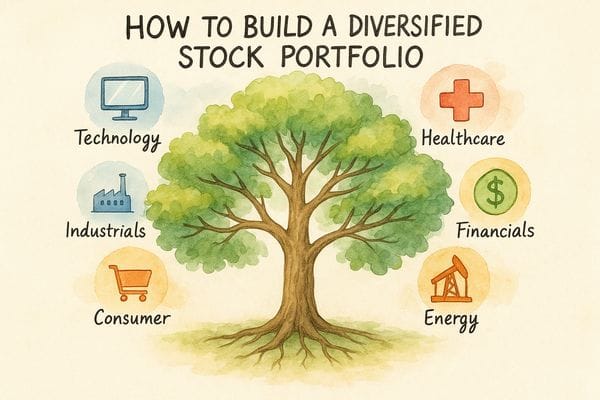
Smart investors understand that spreading investments across various sectors, company sizes, and geographic regions helps protect wealth while capturing market opportunities.
Key Takeaways: Building Your Diversified Portfolio
- True diversification requires 60+ stocks across multiple sectors and regions – Individual stock picking rarely achieves adequate diversification
- International exposure of 20-40% is vital – Non-US stocks gained 12% vs 2% for US stocks in early 2025
- Bonds provide important portfolio stability – Core bond indices posted positive returns during recent stock market declines
- Index funds and ETFs offer instant diversification – Access thousands of securities with single investments at low cost
- Annual rebalancing maintains proper allocation – Market movements naturally alter portfolio weights over time
- Asset allocation should match your timeline – Younger investors can handle more stocks, older investors need more bonds
- Understanding Portfolio Diversification Fundamentals
- Essential Asset Classes for Stock Portfolio Balance
- Strategic Asset Allocation Approaches
- Geographic and Sector Diversification Strategies
- Company Size and Style Diversification
- Risk Management Through Portfolio Balance
- Implementation Methods and Investment Vehicles
- Portfolio Rebalancing and Maintenance
- Frequently Asked Questions
- Building Your Diversified Investment Future
Understanding Portfolio Diversification Fundamentals
Portfolio diversification represents the strategic practice of spreading investments across different asset classes, sectors, and geographic regions to reduce overall investment risk. This approach helps protect your wealth from the volatility that affects individual stocks or specific market segments.
The core principle behind diversification lies in correlation patterns between different investments. When some holdings lose value, others may gain or remain stable, creating a buffer effect that smooths out your portfolio’s performance over time. This balance becomes particularly valuable during market downturns when concentrated positions can experience devastating losses.
Research consistently demonstrates that proper diversification requires much more than owning a handful of stocks. Modern studies reveal that even portfolios containing 60 individual stocks capture only about 86% of available market diversification. True portfolio protection demands exposure to thousands of securities across multiple dimensions including company size, investment style, geographic regions, and industry sectors.
Effective diversification also extends beyond stock selections. A well-balanced approach incorporates different asset classes such as bonds, real estate investment trusts, and commodities. These various asset types often move independently of each other, providing additional layers of protection against market volatility while maintaining growth potential.
Essential Asset Classes for Stock Portfolio Balance
Creating a robust diversified stock portfolio requires understanding the major asset classes that can work together to reduce risk and enhance returns. Each asset class serves a specific purpose within your overall investment strategy.
Domestic Equity Holdings
Your portfolio’s domestic stock allocation should span multiple market capitalizations and investment styles. Large-cap stocks provide stability and steady growth potential, while mid-cap companies offer a balance between growth and stability. Small-cap stocks contribute higher growth potential but with increased volatility.
Within each size category, diversifying between growth and value styles adds another layer of protection. Growth stocks focus on companies expanding rapidly, while value stocks represent established companies trading below their intrinsic worth. These styles often perform differently during various market cycles, helping balance your overall returns.
International Stock Exposure
International diversification has become increasingly important as global markets offer significant opportunities beyond domestic borders. Recent data shows non-US stocks gained about 12% versus only 2% for US stocks through early 2025, highlighting the value of global exposure.
Developed international markets including Europe, Japan, and the United Kingdom provide access to mature economies with different economic cycles than the United States. Emerging markets offer higher growth potential but come with increased volatility and political risks. A balanced approach typically includes both developed and emerging market exposure.
Fixed Income Components
Bonds serve as portfolio stabilizers that often move independently of stocks. Government bonds provide safety and stability, while corporate bonds offer higher yields with slightly more risk. Municipal bonds can provide tax advantages for investors in higher tax brackets.
Bond diversification should consider duration, credit quality, and issuer types. Shorter-duration bonds provide less interest rate sensitivity, while longer-duration bonds offer higher yields but greater price volatility. High-yield bonds can enhance returns but require careful risk management due to higher default probabilities.
Strategic Asset Allocation Approaches
Determining the right mix of assets for your diversified stock portfolio depends on several personal factors including your risk tolerance, investment timeline, and financial goals. Different allocation strategies can help guide your decision-making process.
Age-Based Allocation Models
Traditional age-based models suggest subtracting your age from 100 to determine your stock allocation percentage. A 30-year-old would hold 70% stocks and 30% bonds, while a 60-year-old would hold 40% stocks and 60% bonds. This approach gradually reduces risk as you approach retirement.
Modern versions of this rule suggest subtracting your age from 110 or 120 to account for longer life expectancies and extended retirement periods. These updated models recognize that people may need growth-oriented investments for longer periods to fund extended retirements.
Risk-Based Portfolio Strategies
Conservative portfolios typically hold 30-50% stocks with the remainder in bonds and cash equivalents. These allocations prioritize capital preservation while providing modest growth potential. Conservative approaches work well for investors nearing retirement or those with lower risk tolerance.
Moderate portfolios usually contain 50-70% stocks balanced with bonds and other assets. This middle-ground approach seeks steady growth while maintaining reasonable stability. Many financial advisors recommend moderate allocations for investors with medium-term goals and average risk tolerance.
Aggressive portfolios may hold 80-100% stocks with minimal bond exposure. These allocations target maximum long-term growth but require strong risk tolerance and long investment timelines. Young investors with decades until retirement often benefit from aggressive strategies.
Target-Date Fund Concepts
Target-date funds automatically adjust asset allocation as you approach your target retirement date. These funds start with aggressive stock-heavy allocations when you’re young and gradually shift toward conservative bond-heavy allocations as retirement approaches.
While target-date funds offer convenience, many investors benefit from understanding the underlying principles to create customized allocations. You can apply target-date concepts by periodically rebalancing your portfolio to become more conservative over time.
Geographic and Sector Diversification Strategies
True portfolio diversification extends beyond simple domestic stock and bond allocations. Modern investors need exposure across multiple geographic regions and industry sectors to capture global opportunities while managing regional risks.
Regional Market Exposure
United States markets have dominated global returns in recent years, but this leadership position can shift over time. Investment experts now recommend maximum diversification as the S&P 500 is expected to deliver modest 7% returns in 2025, while other regions may prove more attractive (https://www.morganstanley.com/ideas/2025-market-outlook-portfolio-diversification).
European markets offer exposure to mature economies with different monetary policies and economic cycles. These markets have often traded at attractive valuations compared to US counterparts. Asian markets, particularly Japan and emerging economies, provide access to innovation-driven growth and demographic trends that differ from Western markets.
Currency effects add another dimension to international investing. When the US dollar weakens, international investments become more valuable for American investors. This currency component can enhance or detract from returns, adding another diversification benefit to global allocations.
Industry Sector Balance
Technology stocks have driven much recent market performance, but sector concentration creates significant risks. A diversified approach includes exposure to all major sectors including healthcare, financial services, consumer goods, energy, utilities, and industrials.
Different sectors perform better during various economic cycles. Healthcare and utilities often provide stability during economic downturns, while technology and consumer discretionary sectors may excel during growth periods. Energy and materials can provide inflation protection during periods of rising commodity prices.
Sector rotation strategies attempt to overweight sectors expected to outperform while underweighting those expected to lag. However, most individual investors benefit more from maintaining consistent sector exposure rather than trying to time sector rotations.
Company Size and Style Diversification
Market capitalization and investment style represent important diversification dimensions that many investors overlook. These factors can significantly impact portfolio performance across different market environments.
Market Capitalization Spread
Large-cap stocks represent established companies with market values exceeding $10 billion. These companies typically offer stability, dividend income, and steady growth. Examples include technology giants, major banks, and consumer staples companies that dominate their respective industries.
Mid-cap stocks occupy the middle ground with market values between $2-10 billion. These companies often provide better growth potential than large-caps while offering more stability than small-caps. Mid-cap companies frequently represent regional leaders or specialized industry players.
Small-cap stocks include companies with market values below $2 billion. These investments offer the highest growth potential but also carry increased volatility and business risks. Small-cap stocks often outperform during economic recovery periods but may lag during uncertain times.
Growth Versus Value Approaches
Growth investing focuses on companies expanding revenues and earnings rapidly. These stocks often trade at premium valuations but can deliver exceptional returns when growth expectations are met. Technology, biotech, and consumer discretionary companies frequently fall into growth categories.
Value investing targets companies trading below their intrinsic worth based on financial metrics like price-to-earnings or price-to-book ratios. Value stocks often provide dividend income and can outperform during market recoveries when investor sentiment improves.
Style diversification helps smooth portfolio performance since growth and value stocks often perform differently during various market cycles. Balanced exposure to both styles can capture opportunities across different market environments while reducing overall volatility.
Risk Management Through Portfolio Balance
Effective risk management extends beyond simple diversification to include active portfolio monitoring and adjustment strategies. Understanding different types of investment risks helps create more resilient portfolios.
Systematic Versus Unsystematic Risk
Systematic risk affects entire markets and cannot be eliminated through diversification. Examples include interest rate changes, inflation, recession, and geopolitical events. While you cannot eliminate systematic risk, proper asset allocation can help manage its impact on your portfolio.
Unsystematic risk affects individual companies or sectors and can be reduced through diversification. Company-specific risks include management changes, product failures, or competitive threats. Sector-specific risks might include regulatory changes or technological disruption.
Diversification primarily addresses unsystematic risk by spreading investments across many holdings. When individual stocks or sectors experience problems, the impact on your overall portfolio remains limited if you maintain proper diversification across uncorrelated assets.
Correlation and Portfolio Protection
Correlation measures how similarly different investments move relative to each other. Assets with low or negative correlation provide better diversification benefits than those that move together. Understanding correlation patterns helps create more effective portfolio protection.
Stocks and bonds traditionally exhibit low correlation, making them effective diversification partners. However, during extreme market stress, correlations can increase as most assets move together. This correlation breakdown represents one limitation of traditional diversification approaches.
Alternative investments like commodities, real estate, and international assets can provide additional diversification benefits when traditional stock-bond correlations increase. These assets often respond differently to economic events, maintaining portfolio balance during turbulent periods.
Implementation Methods and Investment Vehicles
Creating a diversified stock portfolio can be accomplished through various investment vehicles, each offering different advantages and considerations. Understanding these options helps determine the most effective implementation approach for your situation.
Individual Stock Selection
Building portfolios through individual stock purchases provides maximum control over holdings and allows customized exposure to specific companies. This approach works well for investors with substantial assets, research capabilities, and time to monitor multiple positions.
Individual stock selection requires significant expertise to achieve proper diversification. Most research suggests you need at least 60-100 stocks across multiple sectors and regions to approach adequate diversification levels. This requirement makes individual stock selection impractical for many investors.
Transaction costs and time requirements also present challenges for individual stock approaches. Maintaining proper diversification through individual securities requires ongoing research, monitoring, and rebalancing that can be overwhelming for individual investors.
Mutual Fund Solutions
Mutual funds offer professional management and instant diversification through pooled investments. A single mutual fund can provide exposure to hundreds or thousands of individual securities, making proper diversification achievable with minimal investment amounts.
Different mutual fund types serve various diversification needs. Total market funds provide broad exposure to entire asset classes, while sector funds offer targeted exposure to specific industries. International funds provide geographic diversification, while bond funds add fixed income exposure.
Fund selection requires understanding expense ratios, management styles, and investment objectives. Lower-cost index funds often provide better long-term results than actively managed funds due to reduced fees and consistent market exposure.
Exchange-Traded Fund Advantages
Exchange-traded funds combine mutual fund diversification with stock-like trading flexibility. ETFs typically offer lower expense ratios than mutual funds while providing real-time pricing and intraday trading capabilities.
ETF variety allows precise portfolio construction across multiple asset classes, sectors, and regions. Core holdings might include broad market ETFs, while satellite positions could target specific themes or regions. This building-block approach creates flexible, cost-effective diversification.
Tax efficiency represents another ETF advantage. The structure of most ETFs minimizes taxable distributions compared to mutual funds, making them attractive for taxable accounts. This tax efficiency can enhance after-tax returns over long investment periods.
Portfolio Rebalancing and Maintenance
Maintaining a diversified stock portfolio requires ongoing attention and periodic adjustments to preserve your target allocation. Market movements naturally alter portfolio weights, potentially reducing diversification benefits over time.
Rebalancing Frequency and Triggers
Annual rebalancing provides a reasonable balance between maintaining proper allocation and minimizing transaction costs. Many investors choose calendar-based rebalancing at year-end or on specific dates to simplify the process and create consistent habits.
Threshold-based rebalancing triggers adjustments when allocations drift beyond predetermined ranges. For example, you might rebalance when any asset class moves more than 5% above or below its target allocation. This approach responds to market movements while avoiding excessive trading.
Market volatility affects optimal rebalancing frequency. During turbulent periods, more frequent rebalancing may be necessary to maintain proper risk levels. Calm markets may require less frequent adjustments, reducing transaction costs and tax implications.
Tax-Efficient Rebalancing Strategies
Tax-loss harvesting can improve after-tax returns during rebalancing. This strategy involves selling losing positions to offset gains from winning investments, reducing overall tax liability while maintaining proper portfolio allocation.
Asset location strategies place tax-inefficient investments in tax-advantaged accounts while holding tax-efficient assets in taxable accounts. This approach can reduce tax drag on portfolio performance without affecting overall diversification.
New contributions provide tax-efficient rebalancing opportunities by directing fresh money toward underweighted asset classes. This approach maintains proper allocation without triggering taxable transactions in existing holdings.
Frequently Asked Questions
How many stocks do I need for proper diversification?
Most research indicates that adequate diversification requires exposure to at least 60-100 individual stocks across multiple sectors, company sizes, and geographic regions. However, achieving this level of diversification through individual stock selection is impractical for most investors. Modern portfolio theory suggests that true diversification requires access to thousands of securities, which is why mutual funds and ETFs have become popular choices. These investment vehicles allow investors to achieve broad diversification with single purchases, making proper diversification accessible regardless of portfolio size.
What percentage of my portfolio should be in international stocks?
Financial experts typically recommend international exposure of 20-40% of your total stock allocation, depending on your risk tolerance and investment goals. This allocation should include both developed markets (Europe, Japan, Australia) and emerging markets (China, India, Brazil). Recent performance data shows international stocks have outperformed US markets in 2025, highlighting the benefits of global diversification. However, the exact allocation depends on factors like your age, risk tolerance, and existing exposure to international companies through US-based multinational corporations.
Should I include bonds in my stock portfolio?
Yes, bonds serve important diversification functions even in stock-focused portfolios. Bonds typically move independently of stocks and provide stability during market downturns. The appropriate bond allocation depends on your age, risk tolerance, and investment timeline. Younger investors might hold 10-30% bonds, while those approaching retirement might increase bond allocations to 40-60%. Recent market volatility has demonstrated that bonds continue to provide portfolio protection, with core bond indices posting positive returns while stocks experienced significant declines.
How often should I rebalance my diversified portfolio?
Most financial advisors recommend rebalancing annually or when any asset class drifts more than 5-10% from its target allocation. Annual rebalancing provides a good balance between maintaining proper diversification and minimizing transaction costs. However, during periods of high market volatility, more frequent rebalancing may be necessary. Some investors prefer quarterly reviews with rebalancing only when significant drift occurs. The key is maintaining discipline and not letting emotions drive rebalancing decisions during market extremes.
Can I achieve diversification with just index funds?
Absolutely. Index funds and ETFs represent one of the most effective ways to achieve broad diversification with minimal effort and cost. A simple three-fund portfolio consisting of total stock market, international stock, and bond index funds can provide excellent diversification across thousands of securities. This approach offers professional-level diversification at low cost while requiring minimal ongoing maintenance. Many successful investors use index fund strategies to capture market returns while minimizing fees and complexity.
What role do sector ETFs play in diversified portfolios?
Sector ETFs can enhance portfolio diversification by providing targeted exposure to specific industries or themes. However, they should complement rather than replace broad market holdings. Core portfolio positions should include total market or broad-based index funds, while sector ETFs can serve as satellite holdings for specific opportunities or tactical adjustments. Over-concentration in sector ETFs can actually reduce diversification by creating unintended sector biases. Most investors benefit from limiting sector-specific holdings to 5-10% of their total portfolio.
How does portfolio size affect diversification strategies?
Portfolio size significantly impacts diversification implementation but not the underlying principles. Smaller portfolios benefit most from broad-based index funds or ETFs that provide instant diversification across thousands of securities. Larger portfolios can support more complex strategies including individual stock selection, alternative investments, and tactical allocation adjustments. However, research shows that even modest portfolios can achieve excellent diversification through low-cost index funds. The key is choosing appropriate investment vehicles that match your portfolio size and complexity preferences.
Building Your Diversified Investment Future
Creating a diversified stock portfolio represents one of the most effective strategies for building long-term wealth while managing investment risk. The evidence from 2025’s market volatility clearly demonstrates that spreading investments across different asset classes, geographic regions, and company sizes provides meaningful protection during uncertain times.
Your diversification journey begins with understanding your personal risk tolerance, investment timeline, and financial goals. These factors determine the appropriate mix of stocks, bonds, and other assets for your unique situation. Remember that diversification requires ongoing attention through regular rebalancing and adjustments as your circumstances change.
Modern investment vehicles like index funds and ETFs make proper diversification accessible to all investors regardless of portfolio size. These tools provide professional-level diversification at low cost while requiring minimal expertise to implement effectively.
Start building your diversified stock portfolio today by assessing your current holdings, identifying gaps in your asset allocation, and implementing a systematic approach to achieve proper balance across all major investment categories. Your future financial security depends on the diversification decisions you make today.


