
According to an Experian study of their consumer credit database, the average American household’s monthly debt payments reached $1,237 in 2025—a 3.2% increase from 2024. Your monthly debt payments are used to determine your debt-to-income ratio, which in turn is an indicator of your ability to repay, so it’s one of the most important numbers lenders look at when you apply for a loan.
What Is Debt-to-Income Ratio?
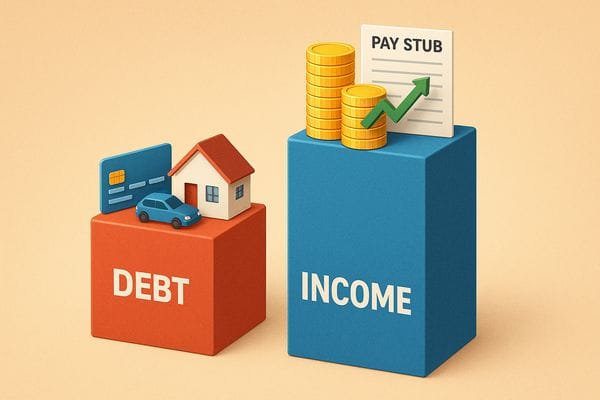
Your debt-to-income ratio (frequently referred to as your “DTI ratio”) compares your monthly debt payments to your gross monthly income. It’s expressed as a percentage. For example, if you earn $5,000 monthly and pay $1,500 toward debts, your ratio is 30%.
This metric helps lenders assess your borrowing capacity. A lower ratio suggests you can handle additional debt responsibly, and a higher ratio indicates you might struggle with new payments.
There are two types to understand: the front-end ratio includes only housing costs like mortgage, insurance, and taxes, while the back-end ratio includes all monthly payments, from housing costs to credit cards and student loans. Many lenders only list the back-end percentage in their requirements, but they will have a threshold for the front-end as well.
Why Lenders Care About This Number
Mortgage qualification standards typically require a back-end ratio below 43%, and 41-42% are common maximums. Some lenders prefer even lower ratios. This isn’t arbitrary—it’s based on decades of data about loan defaults.
When your ratio is too high, you’re statistically more likely to miss payments. Lenders use this information to protect themselves and borrowers from financial hardship.
Your debt service ratio directly impacts loan terms. Better ratios often mean lower interest rates and higher approved amounts. Poor ratios can lead to rejection or costly loan conditions.
Calculating Your Personal Ratio
Gathering Your Numbers
Start by listing all monthly debt payments. Include minimum credit card payments, student loans, car payments, and existing mortgages. Don’t include utilities, groceries, or other living expenses.
Next, determine your gross monthly income before taxes and deductions. Include salary, bonuses, freelance income, and other regular sources. Use pre-tax amounts, not your take-home pay.
Now divide total monthly debt payments by gross monthly income, then multiply by 100 for the percentage; or use our handy Multiple Property DTI Calculator.
Improving Your Financial Health Assessment
Paying down existing debt is the most effective strategy. Focus on one account at a time while maintaining minimum payments on all the others. For help in determining which to pay off first, read about different debt payoff methods and then use our Debt Payoff Methods Calculator to see the results of each strategy applied to your own financial data.
Increasing income helps too, though it’s often harder than reducing debt. Consider side jobs, asking for a raise, or developing new skills for better-paying positions.
Avoid taking on new debt while working to improve your ratio. This includes new credit cards, personal loans, or major purchases on credit. Patience pays off in better borrowing terms later.
| Ratio Range | Lender Perspective | Typical Outcomes |
|---|---|---|
| Below 20% | Excellent | Best rates, easy approval |
| 20-36% | Good | Standard terms |
| 37-43% | Acceptable | More stringent underwriting |
| Above 43% | Risky | Difficult approval |
The Bottom Line
Your debt-to-income ratio is a snapshot of your financial health that lenders take seriously. Keeping it below 36% gives you the best chances for loan approval at favorable terms, although you can still easily find funding with a back-end ratio as high as 43%, which is the current FHA maximum. Focus on paying down debt rather than taking on new obligations, and if you’re considering buying property, monitor this number regularly.